Interview
2018
Text
Film
Journal of Art Criticism : Interview
My introduction to filmmaker Cynthia Madansky’s work was her film TREYF (1998), which explores Jewish identity through the lens of two Jewish lesbians who met at a Passover seder. The film begins with sweet, funny mundanity—grocery shopping—but is followed by a monologue at a table at Katz’s Deli in New York about inclusion, authority, and the titular word for un-kosher, either literally or ideologically. Madansky’s films are often political and deeply prescient, and often revolve around nationalism, the transgression of borders, and nuclear warfare. Working in a self-proclaimed hybrid-essay form, she creates films that are at once poetic and instructive, and thus both beautiful and didactic, a true joy. It was my privilege to speak with her about her current work, the evolution of her career, and art-making in a Trumpian world.
Alexandra Germer: You have two films in progress right now—ESFIR and KG. Could you tell me about them?
Cynthia Madansky: ESFIR is a film inspired by and an homage to the filmmaker and editor Esfir Shub. Shub is most known for her innovative compilation documentary filmmaking methodology, as seen in the most well-known trilogy of her films, Fall of the Romanov Dynasty (1927), The Great Road (1927), and the Russia of Nicholas II and Leo Tolstoy (1928). Shub worked very closely with her contemporaries Dziga Vertov and Sergei Eisenstein and was very influential for an entire generation of mostly female editors who worked in the Kino Fabrika.
In a collection of essays, public speeches and letters by Shub entitled Zhizn’ moya – kinematograf (Cinema Is My Life) 1972, she also includes unrealized “artistic” projects. One of these projects is a seven-part script called Women, a performative piece about the status of women in Russia after the Bolshevik revolution. In 1978 Vlada Petric translated one part of the script to English, and this summer I had the other six parts translated into English. I will be referencing Shub’s script, her approach to filmmaking and editing and will create an experimental 16mm film that looks at contemporary feminism in Russia, specifically through the lens of Russian feminist performance artists from different locations across the country.
AG: And KG?
CM: KG is from a series of short films that interrogate the relationship between cinematic form and language, specifically looking at texts by international women writers. To date, this body of work includes a film based on writings by Clarice Lispector and Simone Weil. I am currently in process on three new pieces, integrating the writing of Hélène Cixous, Zohra Drif, and Katerina Gogou. KG references the writings of Katerina Gogou, an anarchist Greek poet and well-known actress in the ‘70s. These films, shot on 16mm and super 8mm, integrate visuals from very specific locations that relate to the subject matter with performance while addressing issues of language and translation.
AG: It seems like many of your recent works incorporate text in some way.
CM: Each film project entails a great deal of research, so I am always in some ways working with the written word. For ESFIR, although it’s initial inspiration is, in fact, this unrealized script, I am more interested in the form that Shub wanted to introduce and integrate in the piece rather than the actual content or dramatic elements of the text. In ḤĀRĀM, one of my most recent films, I did an extensive amount of research and language was an important part of the narrative.
AG: Clarice Lispector, Hélène Cixous, Simone Weil—would you say you are drawn to making films about women over men?
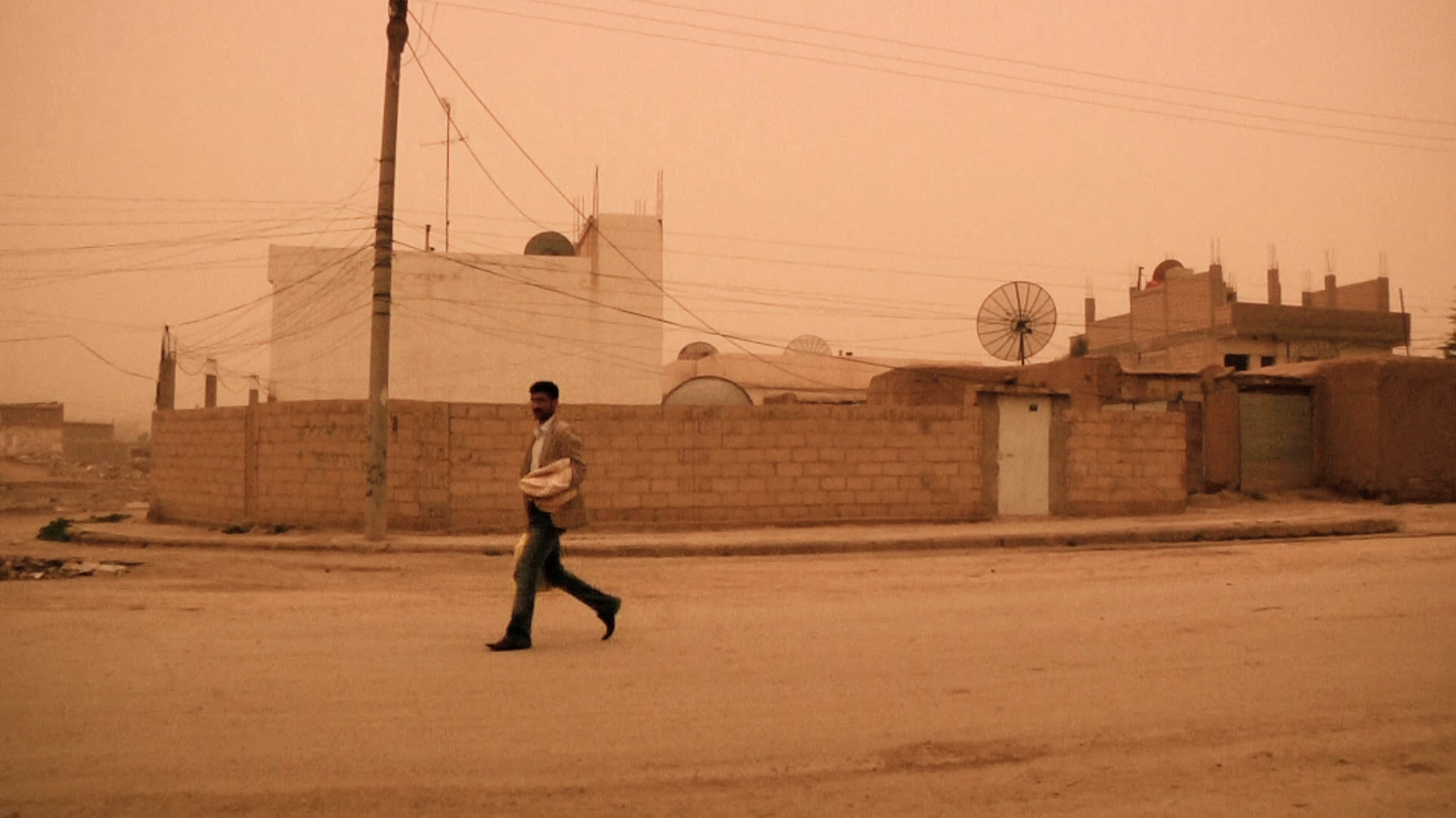
CM: I would contextualize my body of work as one that interrogates political themes through an integration of hybrid poetic forms. For example 1+8 made in collaboration with Angelika Brudniak, shot on sixteen border locations of Turkey and her eight neighbors is a narrative about the political landscape in these border towns, showing the intersectionality of human rights discourses.
AG: You write that you’re interested in themes such a nationalism, the transgression of borders, displacement, nuclear war, and the consequences of politics on the daily life of individuals–all of which feel particularly pertinent in America right now. Do you have any interest in working on a film in America next?
CM: Absolutely, I have made films about US involvement in Iraq, the nuclear legacy in the USA, gentrification in NYC and will absolutely continue to make films here. My next film project, entitled Four Corners will be filmed in New Mexico, Colorado, Arizona, and Utah and will address the nuclear contamination on the land, air, water and people of these states to highlight the nuclear legacy that future generations have inherited unwittingly from the atomic age.
— Alexandra Germer
Columbia University
March, 2018